Thursday, October 4, 2012

Akona Caicos Mask

This is the mask Coconut Tree Divers uses as a rental. It is an excellent entry level choice. Really, you could just skip the mention of entry level all together and say it is a good reliable mask. LeisurePro sells them for about $20.00. With all the different types of people that come into Coconut Tree Divers it is hard to find a one size fits all mask. This one has come up real close to fitting the bill.
 
If you are in the market for a new one, do not feel as though the more money you spend the better the mask. There is no direct correlation regarding more expensive = better mask at all. Read prior reviews on this blog as that has been debunked through hours of underwater use. The Oceanic Pioneer is a prime example as is the Oceanic Shadow, expensive and comfortable but not built to last. Yeah I did just use that line.  
 
Rental gear at our shop is used and abused. Not by all customers, but indeed by some. Kind of like the people who rent cars and run them to the ground. If it does not belong to them, some simply throw things around with little regard to their function or that other people will be using them. Case and point for the Akona Caicos mask. With all the abuse they receive through our shop, they are still providing divers hours of viewing pleasure and comfort.
 
As with most new masks, remember to clear off the coating manufacturers put on them to keep them from scracthing. You need to get that off to help prevent your mask from fogging up. Use a lighter to burn it off, provided it is tempered glass. They usually read Tempered or have a letter T to signify that. You can also use SoftScrub, which is used to clean tiles. When we introduce new masks here at the shop both methods are incorporated. We burn the inside of the lenses with a lighter, rinse them and follow up with a vigorous scubbing with SoftScrub.
 
Hope that helps.
 
Due to suggestions provided by websitegrader.com we are incorporating the Coconut Tree Telegraph blog and the DiveGearReview blog into one. We have also recruited to new writers, Diego and Kaela. They are both doing their PADI Divemaster training here with us and have long ties to Roatan, West End and ultimately to Coconut Tree Divers.
 
Should you have any questions, feel free to contact us.
 
And by all means, if you enjoy the blog sign up. Have a great day!


Saturday, September 15, 2012

Dive Rite Classic Reel


When setting out to buy your own gear, it can be overwhelming with all the things you "should" get and those you "need." In the end, you don't need anything as most places have rental gear. Some will nickel and dime you for a snorkel, weights, mask ect. At Coconut Tree Divers you pay $35 per tank and that includes all your gear. If you have your own gear then the dives are $30 per tank. The point being that you can rent the gear, but it is nice to have your own.


Where does a reel end up in the things you need list? For us it is quite high as we do drift dives on a regular basis. For cave, tec, and  wreck divers it's a must. In our divemaster trainee program we make sure they know how to deploy them without being pulled to the surface by the surface marker buoy. If you are headed down to do your PADI Divemaster course with us, you will need one. It can be as simple as a finger reel, but you will need one. Gone are the days of wrapping 20ft of line to a 2 lb. weight. It's gone from our shop anyhow.  If you end up getting separated from your divegroup it is not a bad idea to have your own signaling device. In a high boat traffic area you are better off sending the marker buoy to the surface before you reach it and hopefully avoiding getting run over. It happens, and having a signal device floating on the surface is no guarantee that some yahoo will not head your way. At one point Rags had to push off the oncoming boat whose captain was paying no attention. And yes she did have an SMB deployed. For the most part, boat captains in Roatan respect them for what they represent, Divers Below. That’s my case for purchasing a reel and marker buoy. This review boils down to an endorsement of one that has been with me for over 4 years.
The Dive Rite Classic Safety Reel can be purchased at; DiveGearExpress for under $45. It has over 100 ft of line. You can now choose the color from white or orange for the line. There’s nothing better than an orange and blue reel, is there?  I’m rooting for the Florida Gators tonight against the Volunteers.

What you might be careful with is the lock down screw. It’s what keeps the reel from unraveling. If you unscrew it too much it will come right off. It's a pain when it comes out all the way as it's made of plastic. After a couple of time of going back in the plastic gets chewed up. Luckily you can purchase them  for about a $1. Apparently this has been addressed in the newer version of the DR Classic Safety Reel. The other consideration is for the actual SMB. How you attach it will help you stay streamlined and keep it from getting caught up while diving sites like Canyon Reef and Hole in the Wall. I use a wrist band and attach it to the reel itself.

If you find these useful, please the time to join the DiveGearReview  Blog. Thanks and have a spectacular day. 

Wednesday, September 12, 2012

Big Blue CF 250 with Goodman's glove


Big Blue, who are they? We had never heard of this dive light company, but Jose first gave them a try by purchasing the CF250 light with neoprene glove for easy hands free operation. At 250 lumens, this light has a double o-ring seal, magnetic switch, a twisting bezel that focuses the beam angle from 6 to 31 degrees, AND it only uses 3 AAA batteries which when freshly charged, will run for over an hour and still shine brightly!

A few months later Marco and Rags also purchased the same light. We have never had any problems with them even after more than 500 dives each. We have them with us on every single dive...divers love it  when you are able to show them the true colors of the reef, even during the day!  It also makes pointing out critters much easier (this is where the narrow beam comes in handy!), without having to get too close to the sensitive coral formations - always a good thing when following the Roatan Marine Park regulations of not getting too close to avoid any incidental damage!

These lights are also great if you are taking pictures or video underwater the hands free operation the G-Glove makes focusing your camera during macro photography much easier.

That's from Jose Silva who is closing in on 1000 PADI Certifications (now en route to Maui with 35 certifications to go!).

The only gripe with the light is the Glove's longevity - the Velcro (tm) attachments do wear out after a while.  It is an excellent concept that, surprisingly enough, has not been adopted by other light manufacturers. It's amazingly useful and comfy. When you need light simply flip over the switch.

Other lights also use double O-ring technology as does this one. To turn them on you unscrew the light. If you keep going they shut off. Keep going after that and they flood. Yikes, that was dumb is when I realized my awesome Hollis light failed. That's a user error I accept.  Was looking for something different this time (duh!). Hence copying Jose and his "light." We give it double OKs.

We purchased a charger and we reuse batteries over an over. We no longer worry about whose batteries they are. The lights have undergone lots of testing, under "live" conditions. Easy conditions in fact. That's why we live here, silly. Again, if they can't work here, how can they work elsewhere? It's not like Monty does the 430 ft Trimix dives every month, not yet anyhow.

The solution for the failing Velcro (tm) on both the palm of your hand and the wrist is as follows; The hand strap can be kept together by wrapping duct tape.  At the time of writing, it has been holding up for over a week. This is after six months of daily use. I do not take the light into confined water on a regular basis. If I had tweet this review and you trusted the content above, it would read something like; The Big Blue CF 250 is a good acquisition.  The wrist Velcro can be folded over itself as shown in the picture.

The cost of the light was about $135 back when we bought them. Today September 12, 2012 it is selling for about $89 atLeisurePro. Be warned, there are some crappy reviews on there, which are quite ridonculous. It does not turn on by unscrewing it. Regardless, we promised to keep these honest.

We are gearing up for the Roatan Fishing Tournament this week-end. As of this entry I had son, little William Alexander.  Thanks for reading. Join the blog and let us know if there is any particular set of gear you would like tested and reviewed. Best wishes from Roatan. If you have any questions feel free to contact us at;  Coconut Tree Divers

Tuesday, August 21, 2012

Hollis S-series Bladder

Two of us use this Hollis S-series bladder, Jose and I. We bought them at about the same time, roughly over a year ago. To date and over 500 dives on each bladder, earn it the double OK. Better yet, the thing is well made.

For those who are thinking about switching to a back-plate, I highly recommend it. With a jacket style BCD, the bladder wraps around your body. As you add air, it fills up around and squeezes you depending on how much air is being added and how snug it has been adjusted to begin with. The jacket style bladders allow for a higher range of motion, meaning that the air can shift from one side to the other throwing off your buoyancy a bit. At times air gets trapped on one side and does not shift over to the BCD hose side. Granted one can become very efficient at controlling this. It is more of a comfort thing when it comes to back-plates. Either jacket or wing,  divers should remember to hold their BCD hoses at the highest point which may include getting into a vertical position to allow expanding air to vent, or any air for that matter.

This really was not meant to be a sales pitch for why one should purchase a back plate, but if you are looking for this type of set-up the Hollis S-series bladder is an excellent choice. The previous bladder I had was a Dive Rite. It unraveled at the seams within 5 months of use. The craftsmanship of the Hollis is heaps better than the Dive Rite. The BCD hose on the Hollis is double stitched and has a bit of protective material sewn to prevent tearing right where it attaches to the bladder itself. The Dive Rite seems to have been put together and never tested. The same thing happened to one Rags, a fellow instructor here at Coconut Tree Divers, used as well a previous instructor. Stick to the the Dive Rite regulator but not the travel wing. This is coming from someone who uses dive gear six days a week. If you plan on using it once a year, don't worry about it.

I purchased my wing from LeisurePro as did Jose. Should you have any questions feel free to contact us via our website.

As of this writing, I am expecting my first child to be born any day now. I will let you know if it turns out to be William Alexander or Gabrielle Alexie.


Thursday, May 10, 2012

Mares JAX Custom Mouthpiece


If you dive, chances that you are using a mouthpiece are at about 100%. If you have your own reg, and you use it regularly chances that you’ve replaced the mouthpiece are also pretty high. Initially divers tend to clench down on the mouthpiece. In time the tabs crack off.  Not to mention that the diver ends up with a sore jaw. Enter a custom mouthpiece. The Mares store down the road here in West End sells them for about $30. It’s quite a lot when you compare it to $5 the standard mouthpieces cost. You know what they say, once you go custom mouthpiece you don’t go back. 
How long do they last? The current one on my reg has lasted over two years. Having one on your reg for 15 years when it’s not being used is not an accurate comparison.  That’s just to cover the heckler who says he’s had one for over 200 years. You know the one who goes to work uphill and then goes home uphill again.
Tree, our equipment manager changes mouthpieces anywhere from 2 a week to about 10. The spike is in direct correlation, we believe, to new divers who chew them up. 
The custom mouthpiece is really comfortable. It gets a double OK. For someone with a small mouth, you might have to trim it. Feel free to comment on your experience with this mouthpiece or better yet, join the blog. 
Thanks for coming and happy bubbles.
Here is a description of the Mares JAX Mouthpiece found at DivingDirect

Thursday, March 22, 2012

Dive Rite First Stage "bulletproof"


As a new diver you will eventually start buying your own gear. Walking into a store can present endless options ranging from more affordable options to not so affordable. We want, as always, to provide an honest guide to help your decision making when it comes to those purchases. The cost, in the end is not really the issue, it is the longevity and performance of the gear that is.

For the last seven years Coconut Tree Divers has been using the Dive Rite 1200 series first stage. In the words of Tree, the equipment manager, it is bulletproof. To date we have 27 in service on the rental rack. They are regularly maintained which includes; taking them apart, cleaning them, replacing O-rings, lubricating and putting them back together. It is all easy to do, although the recommendation is to let a qualified person take care of this for you. If you work in the industry and you do not have access to a "certified tech" they are simple to work on. You need to have the tools to take them apart
and the service kits.
The shop offers four dives a day. The morning boat leaves at 9:00 AM for a deep dive (30m/100 ft. or more) followed by a second dive at around 11:00 depending on the previous dive time. Usually they last anywhere from 45 minutes to 70 minutes. The morning boat gets back to the dock at around 12:30 pm with the next boat going out at 1:00 and 2:30 pm respectively. Afternoon dives are usually limited to 18m/ 60 ft. The point of all this is that the regulators get used constantly. At times, they go from the hands of one diver to the rinse tank and then another diver or student. Usually we add to that a couple of night dives. The Dive Rite first stage is a work horse. They are not very expensive and they are very reliable. When a particular piece of equipment works reliably, the staff ends up adopting it. Several of us have switched to Dive Rite first stages. Coconut Tree Divers has a total commitment to the safety of its divers. A quick read on TripAdvisor will show among several common themes, safety. With that in mind, we stand behind the Dive Rite first stage.


Monty our commercial diver and  Tec Instructor also uses these first stages for Tec dives and as rental gear for the Tec courses.

Bottom line, the Dive Rite first stage receives double OKs.

For a product description visit DiveGearExpress.com


Tuesday, March 6, 2012

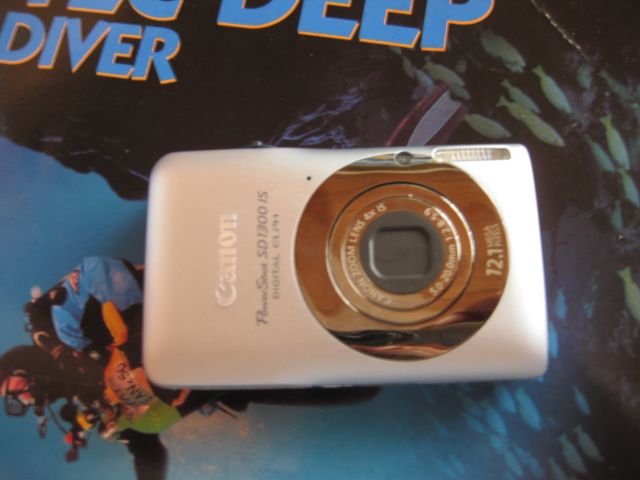
Canon PowerShot SD1300 IS

Some divers love taking underwater pictures as do the staff at Coconut Tree Divers. The question arises time and time again as to which camera and housing to buy. We were looking for an entry level camera for the new underwater photographer. Also, for a solution to use as a rental camera that would not break the bank. With that mentioned, we also wanted a camera that took good quality pictures. Finally we wanted something that was easy to use.

Enter the 12.1 mega pixels Canon PowerShot SD1300 IS Digital Elph. As of this writing the Camera can be purchased via eBay for $150.00 or less. It is a small and compact point and shoot, likely the standard these days. The housing we selected for this camera is a Canon WP-DC36. It retails on Amazon for $190. There are several waterproof cameras but as of late they are limited to about 33 feet. There is plenty of life at that depth, but our morning dives are generally down to 100 feet. The afternoon dives max out at 60 feet. Until these depths increase we will continue purchasing housings for our cameras.

Originally we were thinking of purchasing the Canon PowerShot G12. That is an excellent choice, but quite more expensive. Jose, our in house photographer started searching and purchased an SD1300 for himself. It has worked superbly. It is extremely easy to use and provided you put a big enough SD card in it, video is also available. As part of our Divemaster program we have started to get DMts who are further along in the program to take pictures. We want them to experience taking the pictures and uploading them to social media sites. Also to be able to put together movie clips which may also be shared online or on a flat screen at the shop. Many of the shots on our Facebook page come from this little camera. We are not implying that the more expensive solutions do not work, simply that this one does. As someone trying to purchase all your gear, the dollars add up quickly.

It has an underwater setting. The flash can be turned on or off with ease, macro mode is available and the video mode is also accessible underwater. Some cameras don't let you switch. This camera gets a double OK.